The brief on a tight spinach block
The grower wanted to see how laser weeding would sit on a spinach block where the crop was already established and the rows were narrow. The main question was not theory, it was whether early passes could be timed to the weed stage and the bed shape without upsetting crop plants or leaving the soil surface worked over.
The block sat in a wind-affected Stellenbosch pocket with mixed bed edges and a few low spots that held moisture longer after irrigation. That mattered, because weed flushes did not come through evenly across the whole field. We had to read the patchwork, not the map on paper.
We treated the trial as a practical check on access, row definition and how much room there was for a tractor-drawn laser unit to move cleanly between beds. Spinach leaves can spread low and wide, so the operator needed a steady line and a clear view of the weed targets close to the crop row.
What the field needed before the laser pass
Before any run, we looked at bed shape, crop spacing, weed size and the condition of the surface crust. Laser weeding works best when weeds are at an early stage, before they get too woody or shaded by the crop. The camera-guided system needs enough contrast to pick out the weed growing point and direct the beam into it.
- Bed shoulders needed to stay firm, with no loose sand spilling into the row line.
- The spinach stand had to be even enough for the operator to read crop gaps without guessing.
- Weeds were checked for leaf stage and height, not just presence.
- Travel lines into the block had to suit tractor movement without clipping row ends.
- The schedule had to fit the weed flush, not the other way round.
Because the work is herbicide-free and leaves no soil disturbance, the block did not need any cultivator pass before or after. That was useful where the grower wanted to protect structure in the beds and keep irrigation lines, mulch edges and young crop roots undisturbed.
How the trial was run in the field
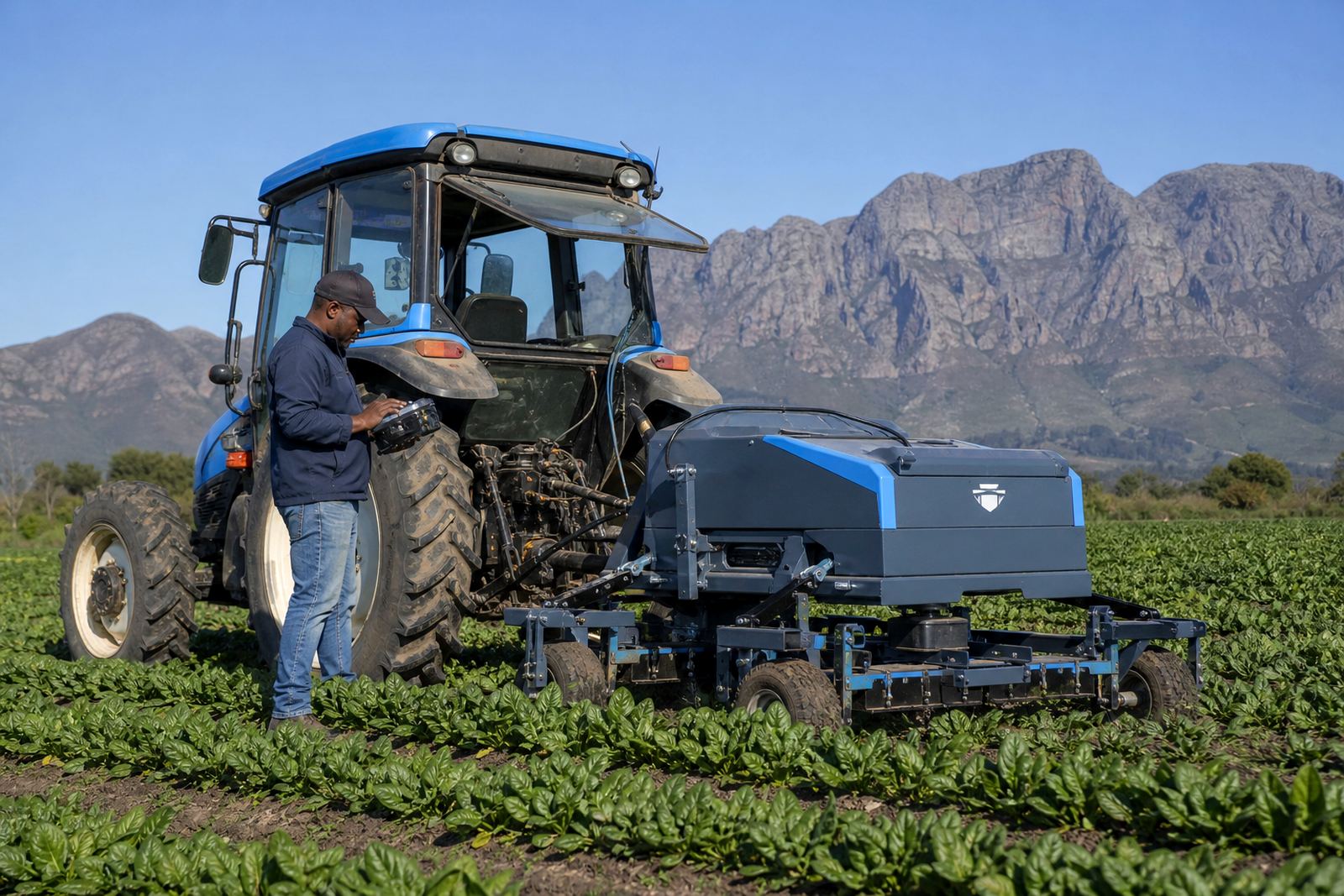
We supplied the tractor-drawn laser weeding unit, a trained operator and field scheduling support from our Cape Town base. The first visit was used for an arrival site check, then a trial strip run was marked out across a section that showed the range of bed shapes. That gave the grower a direct look at how the unit tracked through straighter rows and through the slightly uneven parts.
The machine relied on camera-guided weed detection. Once the system identified a weed target, the laser was directed onto the growing point, which is the part the weed needs to keep growing. The operator stayed focused on row quality, crop proximity and the general weed pressure across the pass.
- We kept the first pass short so the grower could inspect treated strips against untreated strips.
- We noted where bed crowns sat too high or too low for clean travel.
- We flagged where weed pressure was low enough for a lighter pass and where it was not.
- We recorded the practical field speed range for that block, which moved with weed density and row regularity.
Timing notes from the two week window
The trial ran over two weeks, with the first week used for assessment and strip setup and the second week for checking the effect of the selected timing on fresh weed flushes. That window mattered because early intervention only works if the weed stage is right. Wait too long and the weed gets harder to target cleanly. Move too soon and the flush can be uneven enough to waste a pass.
In this block, the best sections were the ones where the crop was established but still open enough for the camera system to distinguish the weed targets. The tighter parts of the rows asked for slower field speed and more care around the bed shoulders. That is normal on spinach, especially where leaf spread closes over the row line before the weed pattern has settled.
The grower also wanted a view on repeat pass planning. We mapped where a second pass would make sense if later weed emergence followed the same pattern, and where one pass would be enough for that growth stage. Field scheduling was built around that, so the block would not be treated as if every strip behaved the same.
What the grower saw after the strip run
The main result was clarity. The trial showed which bed shapes were suitable for laser weeding and which sections needed cleaner row definition before wider use. It also showed how early intervention could be practical on spinach, provided the weed stage was watched closely and the block was entered before weeds got past the small seedling stage.
The grower could compare treated strips with untouched strips and see where the laser pass had removed the weed points without working the soil. That mattered in a spinach crop where surface disturbance can create fresh weed germination later on. The trial also showed that field speed was not fixed. It shifted with weed pressure, crop uniformity and the amount of steering correction needed at the bed ends.
- Early intervention suited the more even sections of the block.
- Uneven bed shoulders needed better prep before a full programme.
- The crop tolerated the trial layout without soil disturbance.
- Future passes would need close timing around weed emergence.
Next steps on a similar spinach block
If we were setting up the same sort of spinach job again, we would start by checking bed shape before the weed flush got away from the crop. That would let us line up the camera-guided unit with a cleaner row pattern and avoid wasting time on sections that were never going to give a fair result. It also helps the operator keep a steadier line where the crop edges are soft.
We would keep the first intervention narrow, then widen the plan only where the early strip proved practical. On blocks like this, a multi farm programme only works when each field is scheduled to its own weed stage. The same unit can handle different crops such as onions, carrots, lettuce and brassicas, but spinach needs a sharper eye on leaf spread and bed definition.
The grower later used our contact form to continue planning for other vegetable blocks in the area, but this trial stood on its own as a useful check on crop timing, field access and the limits of early laser weeding in real conditions.
Key facts
| Project | Stellenbosch Spinach Grower |
|---|---|
| Crop | Spinach |
| Location | Stellenbosch, Western Cape |
| Service mix | Field Assessments, Trial Strip Runs, Crop Timing Plans, Field Scheduling |
| Equipment | Tractor-drawn laser weeding unit with trained operator |
| Trial window | 2 weeks |