

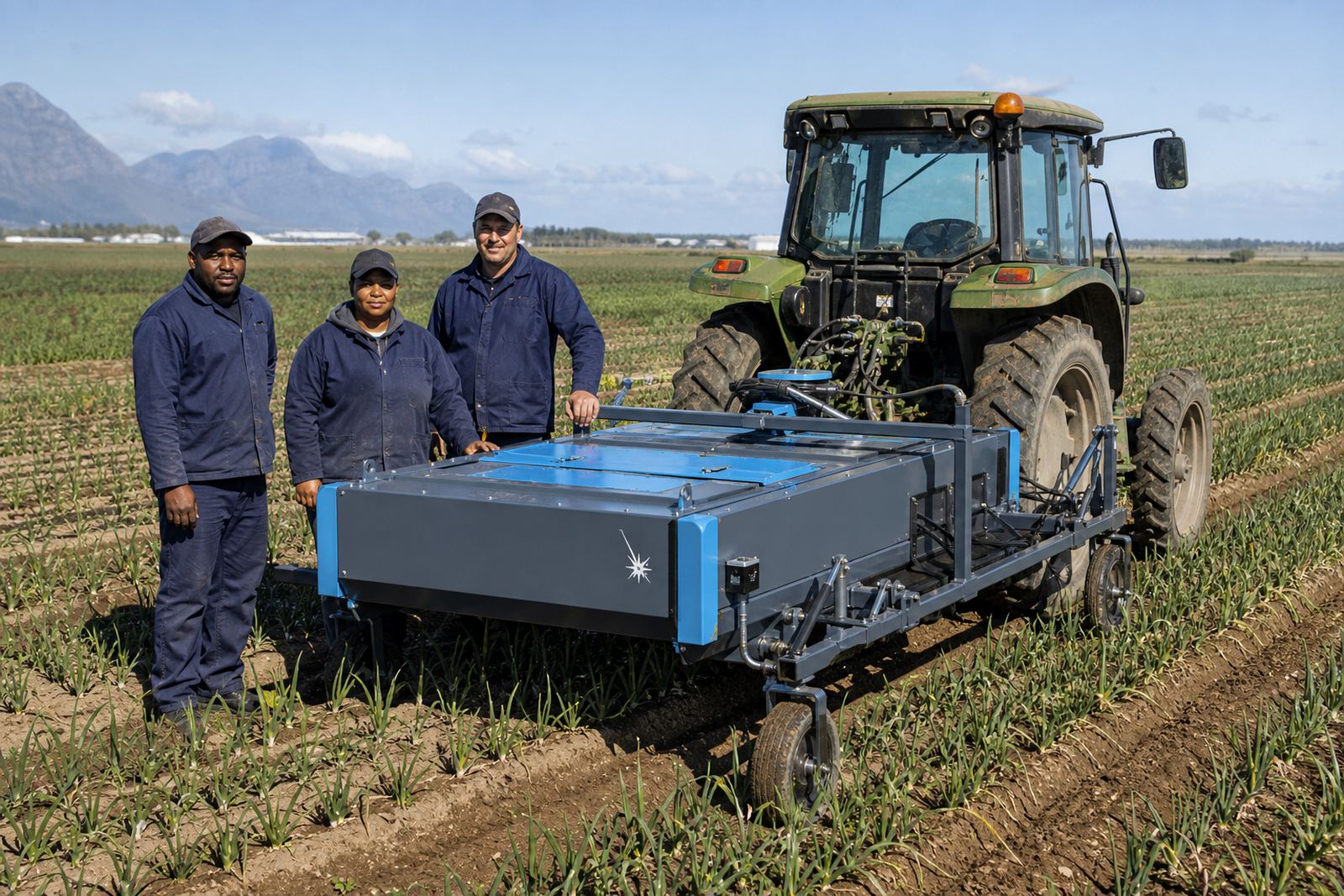
A Philippi base shaped by farm realities
Our base in Philippi keeps us close to vegetable ground, packing activity and the daily rhythm of open fields. That matters when the job is not just about a machine, but about timing, access, row layout and the stage of the weeds in the soil.
Mandla Adonis leads the business with a practical view of what growers need from contract laser weeding. Around him is a team that handles field planning, operator coordination, site checks and grower communication without making the process feel heavy or unclear.
How the laser work fits vegetable rows
Laser weeding uses camera-guided detection to identify weeds in the row and the spaces beside crop plants. The laser then targets the weed growing point, which is why timing matters so much and why young weeds are easier to manage than established ones.
Our tractor-drawn units are suited to row crops such as onions, carrots, lettuce and brassicas. The work is carried out with trained operators, and the field speed changes with weed pressure, crop spacing and the condition of the block on the day.
- Herbicide-free weed control for crop rows and inter-row areas
- No soil disturbance from cultivating or hoeing passes
- Useful on fields where weed timing must be kept tight
- Best planned around crop stage, weed stage and row visibility
What the team handles on the ground
LaserWeeder Hire is organised around the details that sit behind a clean pass. Pieter Mokoena manages field scheduling, while Anele Khoza keeps operations aligned with the work that is already booked. Johan Daniels leads operator work in the field, and Ruan Mkhabela keeps the unit ready for travel and day-to-day service needs.
That structure helps when a grower has more than one block, or when a programme needs to move between farms in different towns. We also coordinate travel, arrival checks and repeat pass planning so the work stays matched to the field conditions rather than forced into a fixed pattern.
- Field assessments before the first pass
- Crop timing plans based on weed stage
- Trial strip runs where a block needs checking
- Multi farm programmes across separate growing areas
- Post pass reporting for farm records and follow-up planning
Grower decisions that are easier to plan early
Growers usually want to know whether a block is worth scheduling, when the weeds are in the right stage and how the work will fit around irrigation, harvest and labour on the farm. Zanele Naidoo handles grower liaison with that kind of practical conversation in mind, keeping the focus on field facts rather than vague promises.
Lerato Letsoalo supports the booking side, which matters when a season booking has to cover more than one crop window. In our work, a small timing shift can matter more than a dramatic gesture, so we pay attention to leaf cover, row definition and how quickly a field can be covered without rushing the operator.
Where our work reaches beyond Cape Town
Although the base is in Philippi, the work regularly reaches farms in Ceres, Grabouw, Tzaneen, Bela-Bela, Nelspruit, Howick and Bethlehem. Those areas differ in climate, crop mix and field access, so each programme needs its own route plan and crop timing notes.
Contract laser weeding can suit farms that want a repeatable programme rather than a once-off rescue pass. Some growers need a short trial strip before a wider booking, while others need a season plan that follows the same block through more than one weed flush.
- Western Cape vegetable blocks with narrow timing windows
- Limpopo and Mpumalanga farms handling warm-season growth
- KwaZulu-Natal and Free State growers with different soil and moisture patterns
- Season bookings for blocks that need phased treatment
The working habits that keep the job grounded
We keep the work straightforward. Measure the block, check the crop stage, look at the weed pressure, confirm the row pattern and set the machine to suit what is actually in front of us. That is the kind of discipline that matters more than big talk, because the crop does not care about wording.
Our contact form is the cleanest way to send a farm brief. If a grower needs field assessments, operator supplied work, travel coordination or grower consultation, the details can be set out there without guesswork, and the next step can be planned around the block in front of us.