

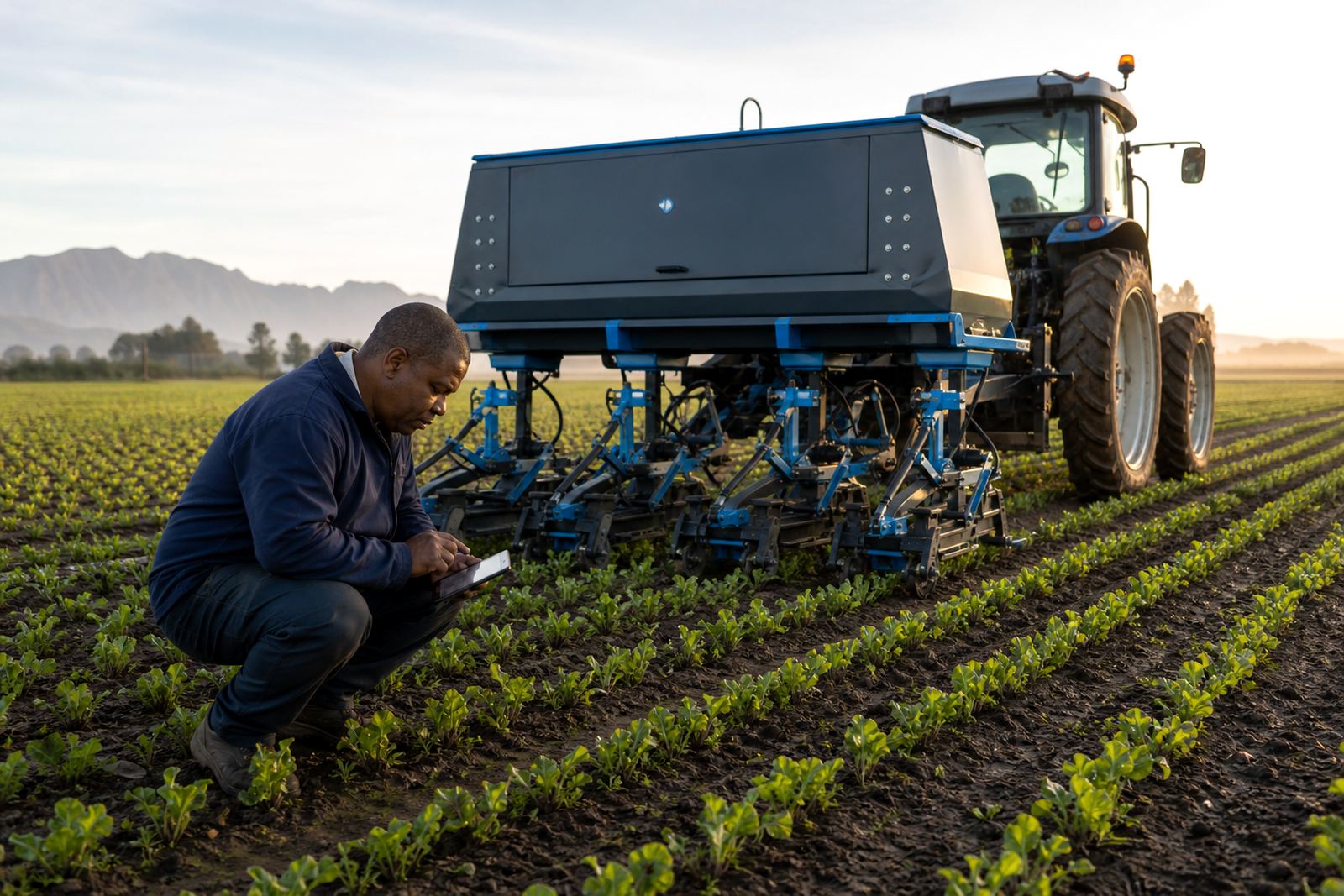
A Philippi base shaped by vegetable ground
The first work came from vegetable land around Cape Town where rows are tight, ground conditions change fast, and weed pressure does not wait for a convenient week. That setting shaped the way the service was built: tractor-drawn laser weeding, trained operators, and field planning that fits the crop rather than forcing the crop to fit the machine.
From the beginning, the job was never treated as a novelty. It had to make sense in real production blocks, with onion, carrot, lettuce and brassica plantings, plus the gaps between crop plants where hand weeding becomes slow and expensive. The base in Philippi kept the work close to growers who know how quickly a field can shift after rain, wind or a missed pass.
How the craft grew beyond one kind of field
As more growers asked for the service, the work moved from isolated strips to full season planning. That meant learning how weed stage affects treatment, when young weeds are worth targeting, and how plant spacing changes the machine line through a block. The operator does not simply drive through a field; the pass has to match crop stage, weed pressure and the condition of the soil surface.
Laser weeding itself depends on camera-guided weed detection and focused energy aimed at the weed growing points. The ground is left undisturbed, which matters in lighter soils and in beds that need to stay stable for the next stage of crop growth. In practice, the timing of the pass is often as important as the pass itself.
- Field assessment before the block is scheduled
- Crop timing plans for young and established plantings
- Trial strip runs where a grower wants a close look at the method
- Repeat pass planning when weed emergence continues
The growers who call on the service
The customers are vegetable growers working across Western Cape, Limpopo, Mpumalanga, KwaZulu-Natal and the Free State. Some manage one farm, others move between several sites and need a practical schedule that keeps labour and machinery lined up. The work suits growers who want a herbicide-free option, but also those who need a clean pass between crop plants without upsetting the bed structure.
Row crops are where the method shows its value most clearly. Onion, carrot, lettuce and brassica fields all bring their own spacing, weed types and timing pressures. A field in Philippi does not behave the same way as one near Tzaneen or Bethlehem, so the service has had to stay attentive to local conditions rather than use a fixed pattern everywhere.
- Single-farm programmes for focused seasonal blocks
- Multi farm programmes for growers with spread-out land
- Travel coordination for distant sites and changing access plans
- Grower consultation around crop stage and weed pressure
The team behind the passes
The business today is carried by a small team that keeps the work grounded. Mandla Adonis leads the company direction, while the rest of the team handles the day-to-day movement of people, equipment and field decisions. That structure matters because laser weeding is not only about the machine. It depends on the person setting the pass, the person checking the field, and the person making sure the job is ready before the unit arrives.
Anele Khoza manages operations, Pieter Mokoena handles field scheduling, Zanele Naidoo works on grower liaison, Johan Daniels leads operator work, Lerato Letsoalo coordinates service details, and Ruan Mkhabela oversees the workshop side. Each role supports a different part of the same job, and that keeps the service practical instead of rushed.
- Arrival site checks before work starts in the block
- Operator supplied for the scheduled pass
- Post pass reporting for the grower record
- Workshop support for the tractor-drawn unit
What a field pass really depends on
A laser weeding pass is shaped by weed pressure, crop size, row layout and the pace that the block can take without unnecessary stress. If weeds are too advanced, or the crop is too young for the spacing, the timing has to be rethought rather than forced. That is part of why the planning side grew alongside the operating side.
The speed across a field changes with the pressure in front of the machine. Dense weed growth, narrow rows and uneven emergence can slow the work, while cleaner blocks allow a more regular pace. Even then, the aim stays the same: target weeds at the growing point, keep the crop safe, and leave the soil surface undisturbed.
For growers, the main value has often been in a service that fits the season without adding extra disturbance to the land. It is a field job, not a showroom idea, and the details have to stand up in wind, dust and wet patches alike.
How the service is arranged today
The present-day service is set up for scheduled work rather than ad hoc improvisation. That suits growers who need field assessments, crop timing plans, travel coordination and repeat pass planning across several sites. The Philippi base keeps the operation close to Cape Town production areas while the field schedule reaches further afield when the season calls for it.
What has stayed consistent is the practical way the team works with growers. Clear block information, crop stage, weed pressure, access details and timing all matter. Those pieces decide whether a laser pass is ready, and they also shape how the next pass is planned when a block needs another round later in the season.
- Season bookings for planned farm programmes
- Field scheduling for scattered blocks and larger rotations
- Trial strip runs where a grower wants to test a section first
- Repeat pass planning for ongoing weed emergence
The story of LaserWeeder Hire is not a showroom story. It is a field story built around vegetables, timing and the daily reality of weed control on South African farms. That is still the work today, only with a steadier team and a wider reach than when it first began in Philippi.
The way growers first describe the service
Most growers do not ask for a theory lesson. They ask whether the unit can fit the crop, whether the pass can be timed around the block, and how the work will sit beside the rest of the season. Those are the questions that shaped the business early on and still shape it now.
The answer usually begins with the field itself. Once the crop stage, spacing and weed pressure are seen on site, the plan becomes much easier to set. That is why our contact form remains the main way growers start a conversation with the team, especially when more than one farm needs to be scheduled at once.
- Philippi, Cape Town base for local coordination
- Field work across Western Cape, Limpopo, Mpumalanga, KwaZulu-Natal and the Free State
- Operator-led service with trained machine handling
- Consultation that follows crop timing rather than guesswork