When herb rows give the camera room to work
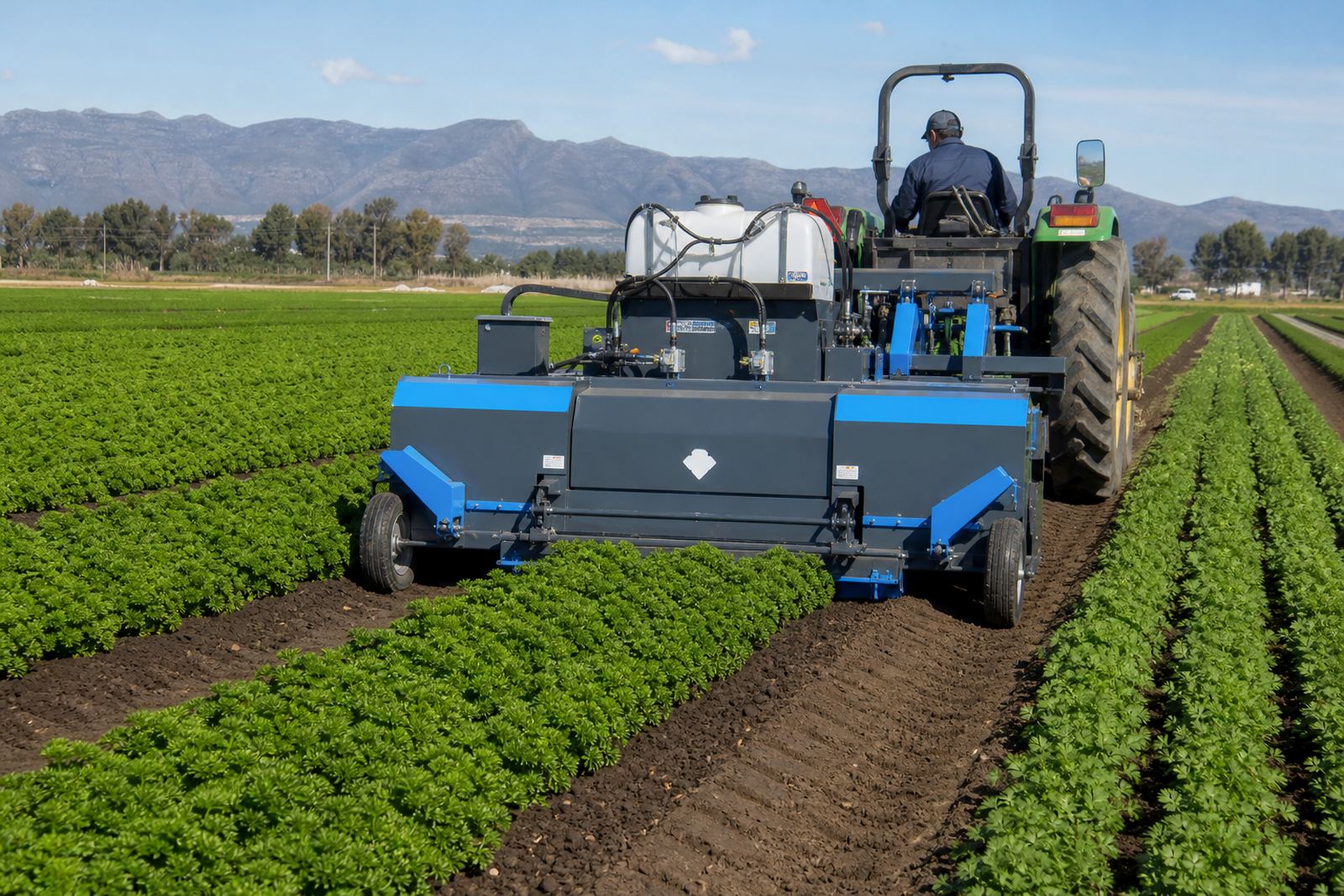
Herb blocks are different from broadacre vegetables. Basil, coriander, parsley, dill and similar rows can be narrow, quick to close over and sensitive to rough handling. Laser weeding works best where the row spacing is regular, the crop has enough separation from the inter-row zone and the weeds are still small enough for the detection system to read them cleanly.
That means the best results usually come from rows that were planted neatly and kept true from the start. If the crop is leaning, patchy or uneven in emergence, the operator has less room to run close to the plants. In those blocks, timing matters more than speed and the field plan needs a careful first look before any pass is scheduled.
For herb growers in Philippi, Ceres, Grabouw and similar production areas, a field assessment is usually the first step. The crop geometry, bed shape, row centre line and weed mix all affect whether the tractor-drawn unit can work cleanly without disturbing the soil.
What the unit is doing in the row
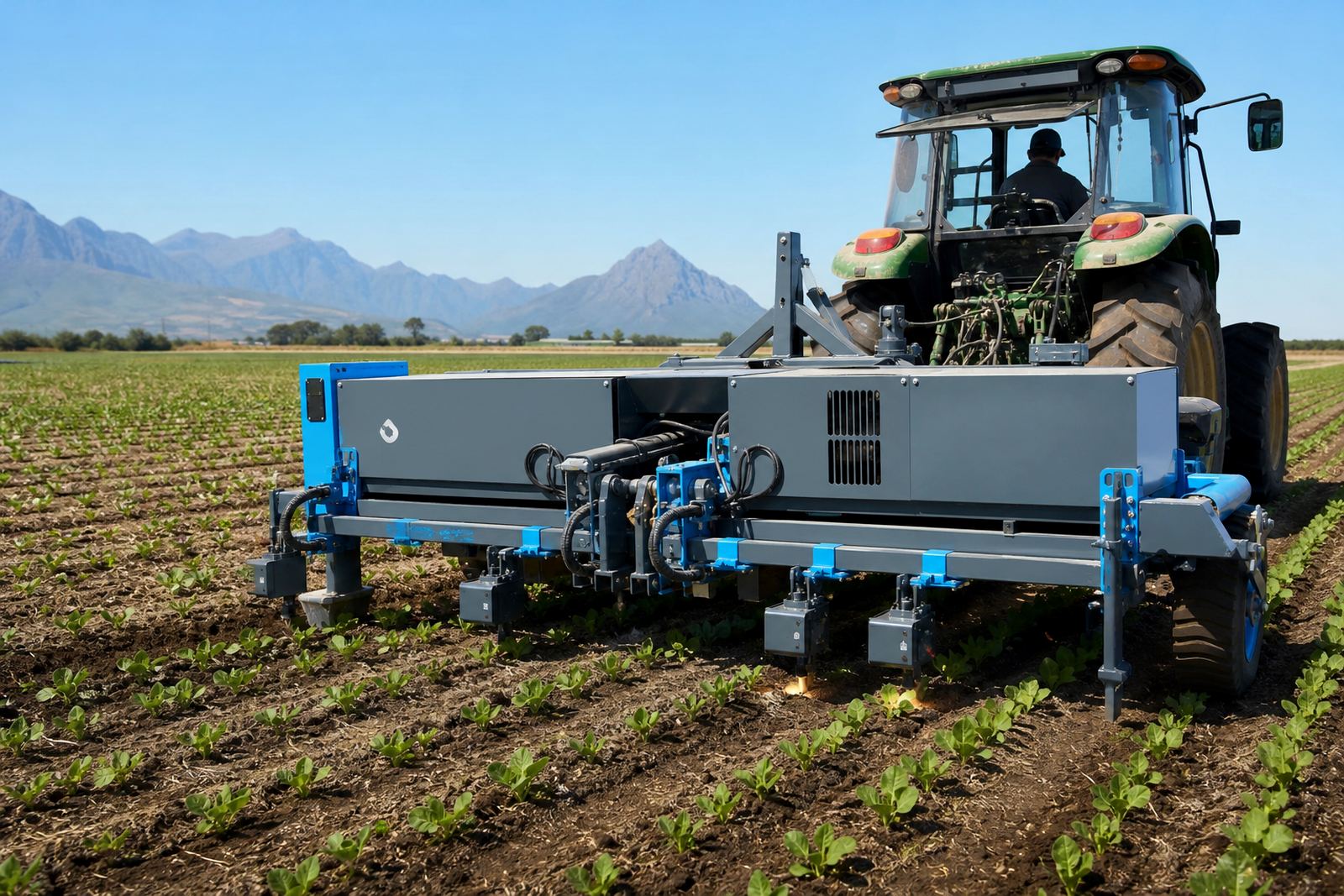
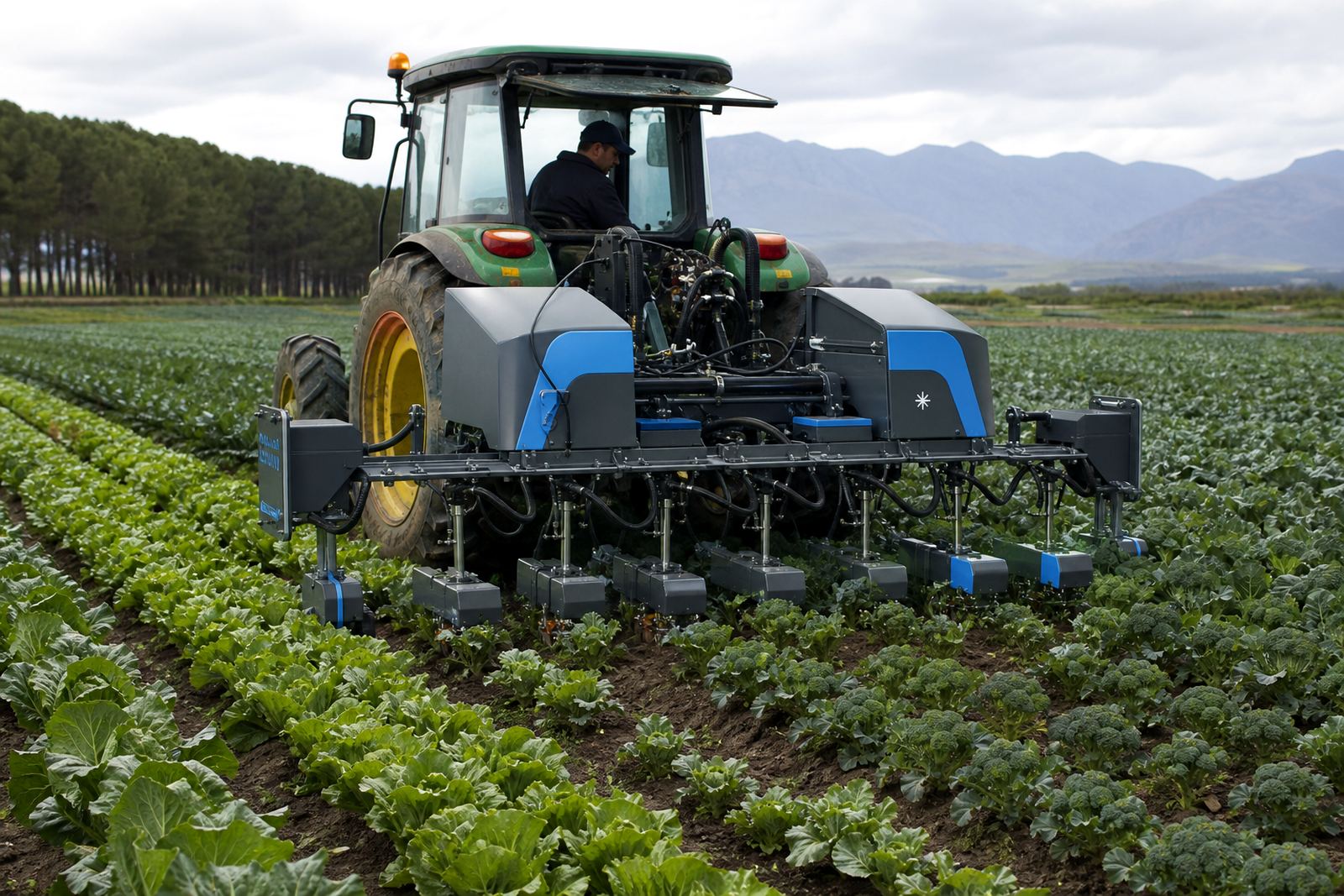
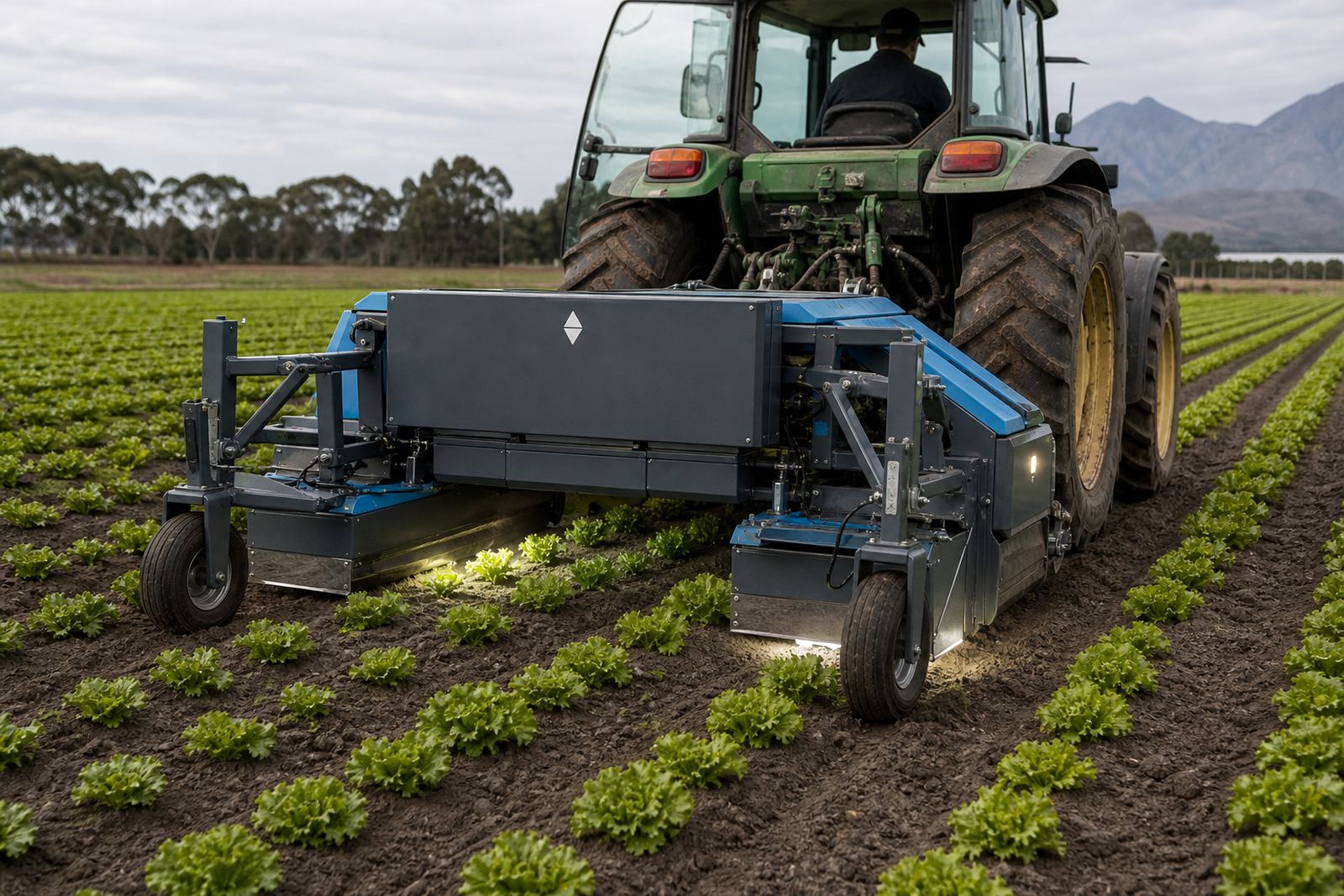
A laser weeding setup uses cameras to spot weeds, then directs lasers onto the weed growing points. The crop is protected through timing, calibration and the way the unit reads the field. The work is mechanical in its motion but not by contact, so the soil stays undisturbed and there is no spray pattern to manage across the beds.
For herb rows, that matters where the crop is delicate or where repeated herbicide use is not the preferred route. A tractor-drawn unit can move between rows while the operator watches crop size, weed pressure and field condition. Field speed is not fixed. It changes with weed density, the straightness of the rows and how much work the cameras need to do at ground level.
- Camera-guided weed detection for visible weed points
- Lasers applied to the weed growing point only
- Tractor-drawn unit with a trained operator in the cab
- No soil disturbance from blades or cultivation tools
- Best suited to row crops with clear spacing and even geometry
Planning herb rows before the first pass
Good planning begins long before the tractor enters the field. Herb rows need a clean line, predictable plant spacing and enough clearance for the camera system to read between the crop plants. If the beds are too loose or the crop was planted off-line, the operator may need a slower pass or a narrower work window.
Growers also need to think about weed stage. Small weeds are easier to target than mature growth with thicker stems or more leaf mass. A trial strip run can help the team judge whether the field is ready for a full pass or whether the block should be held for a few more days. That judgement is practical, not theoretical, and it depends on what is visible on the day.
Repeat pass planning is often useful for herbs because the crop can still be forming while later flushes of weed emerge. The schedule must fit the block, the access road and the rest of the farm programme. For growers working across South Africa, travel coordination matters too, especially when the field list runs from the Western Cape to Limpopo or Mpumalanga.
- Check row geometry and crop height before booking a pass
- Match the pass to weed stage, not only the calendar
- Allow for turn space at headlands and tight corners
- Keep irrigation lines, markers and loose debris out of the row path
- Use field scheduling when more than one farm needs the same unit
Common mistakes that make the job harder
The most common issue is waiting too long. Once weeds are too large, the laser has more work to do and the pass may be slower. Herb rows can also be tricky when they are uneven after transplanting, or when the crop has dropped over the bed edges and hides the inter-row zone.
Another mistake is assuming every herb block will behave the same. Basil under warm weather does not track the same way as a cooler parsley block, and a lightly infested field is not the same as a flush after rain. The operator needs to see the field as it is, not as the plan hoped it would be.
At times growers also understate the role of access. Narrow entrances, soft shoulders and awkward headlands can slow the whole programme. If the farm team leaves the block until the crop is too tall or the weeds are too far gone, the pass becomes a correction exercise instead of a maintenance pass.
Typical service set for herb growers
LaserWeeder Hire works with a practical set of services that fit herb production blocks as well as larger vegetable programmes. For a one-off block or a full seasonal run, the team can put together a field plan that suits the row layout and the crop stage.
That usually includes a field assessment, crop timing plan, trial strip runs and post pass reporting where the grower wants a record of what was covered. Multi farm programmes are common where one grower has herb rows in more than one district, or where the same operation also runs onions, carrots, lettuce or brassicas in nearby blocks.
- Field Assessments
- Crop Timing Plans
- Operator Supplied
- Field Scheduling
- Travel Coordination
- Trial Strip Runs
- Repeat Pass Planning
- Season Bookings
- Multi Farm Programmes
- Arrival Site Checks
- Post Pass Reporting
- Grower Consultation
Budget ranges in rand for herb rows
Budgets for herb rows are usually shaped by block size, travel distance, weed pressure and how many passes are needed over the season. A small herb block near the base in Philippi will not carry the same cost profile as a split programme in the Free State or KwaZulu-Natal. The field plan has to account for the tractor, operator time, travel coordination and the number of blocks on the day.
As a working guide, growers often look at project values from about R12,000 for a small trial strip or a short block visit, through to R45,000 to R120,000 and more for larger seasonal herb programmes with repeated passes and multi farm coordination. Those figures can move quite a bit depending on row length, access and how much of the crop needs attention.
For herb rows, the sensible question is not only what a pass costs, but how the whole programme fits the season. A block that is well timed may need fewer corrective passes than a field left until weeds are already well established. That is why the timing plan matters as much as the unit itself.